note · growing
Giving it a brain
The model knows nine sentences, so Claude gets one tool with one argument, reads the board from the camera, and never drives the arm.
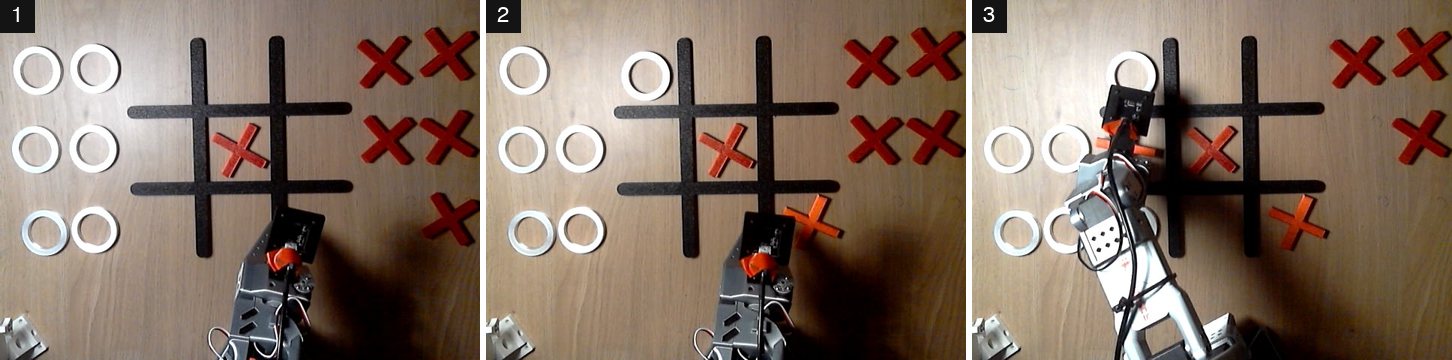
The first game with Claude, near the end of each of the arm's three moves:
middle center, bottom right, middle left.
The model that moves the arm is not smart. It imitates, and in training it saw exactly nine sentences:
put the red X in the {top|middle|bottom} {left|center|right} cell"Put it in the corner" means nothing to it. So the thinking goes to Claude,
and Claude never drives the arm. It gets one tool with one argument,
place_x(cell). The code refuses a taken or unknown cell and writes the
sentence, letter for letter as in the training data.
Seeing the board. The frame from the top camera is rotated, cropped to the grid and shown to Claude, which reports the nine cells. On eight frames from real runs, each read twice, all 16 reads were correct.
No typing. The code checks the pick slot for a red X, notices when the arm is back at rest, and compares frames locally until a new piece shows up. Only then does Claude read the board again.
Dashboard. A local page with both cameras, the board and a stop button. The games so far were played from the terminal, so I have only seen it replay a recorded game.
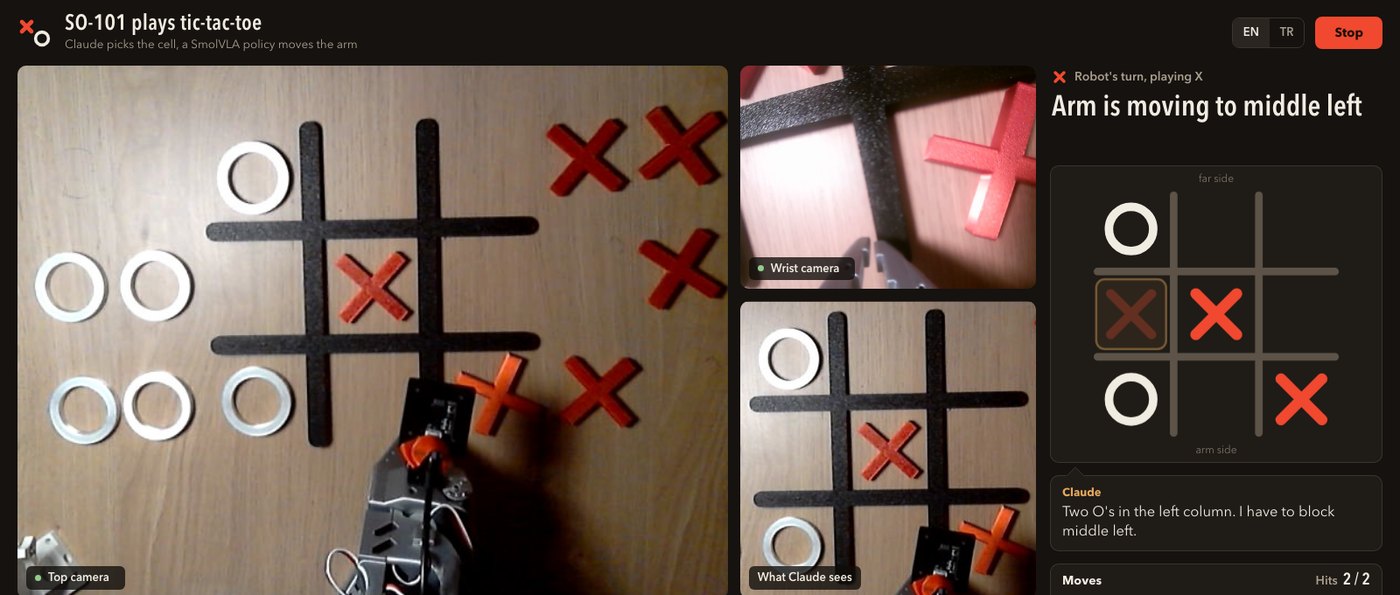
The dashboard replaying a recorded game with scripted text. This is not a live game.
The split is not my idea: an earlier open SO-101 tic-tac-toe project was
built the same way, and I used it as a reference. The code is in
xox/.